 Hex NFC
Hex NFC
Everything the others charge for. Free.
A complete NFC reader, writer and tag editor for iPhone. Every record type, every common chip family, the protection commands and the memory tools. Free, and the source is published with the release.
iPhone · iOS 17+ · Free · Source-available
What it does
Read anything. Write nearly anything.
Eighteen record types
Text, links, app links, Wi-Fi credentials, contacts, mail, phone, SMS, FaceTime, maps, Bluetooth handover, crypto addresses, Shortcuts, templated data and raw bytes, plus social profiles across 22 platforms and search across seven engines.
Tags that explain themselves
When a chip can't be matched, the scan shows the decoded version block: vendor, product family, memory size. It will not guess a memory map it cannot verify, and it will not format a tag it cannot identify.
Presets and a library
Save a tag layout, share it as a file over AirDrop, and write a whole stack of blanks from it. Ninety days of scan history, pinnable, with optional iCloud sync that is off by default.
QR to NFC
Point the camera at a QR code and turn it into a record. The frame is processed on the device and nothing is uploaded.
On the screen
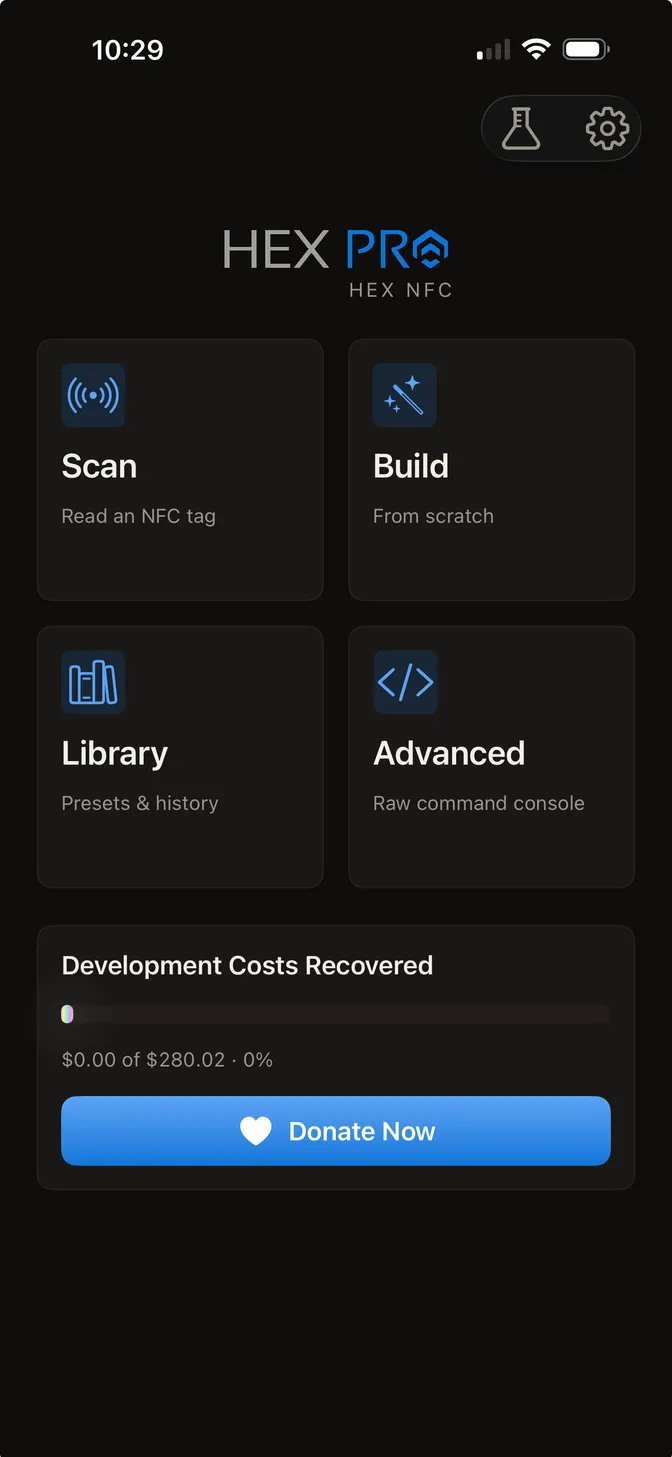
Scan, Build, Library, Advanced. Plus the costs bar. 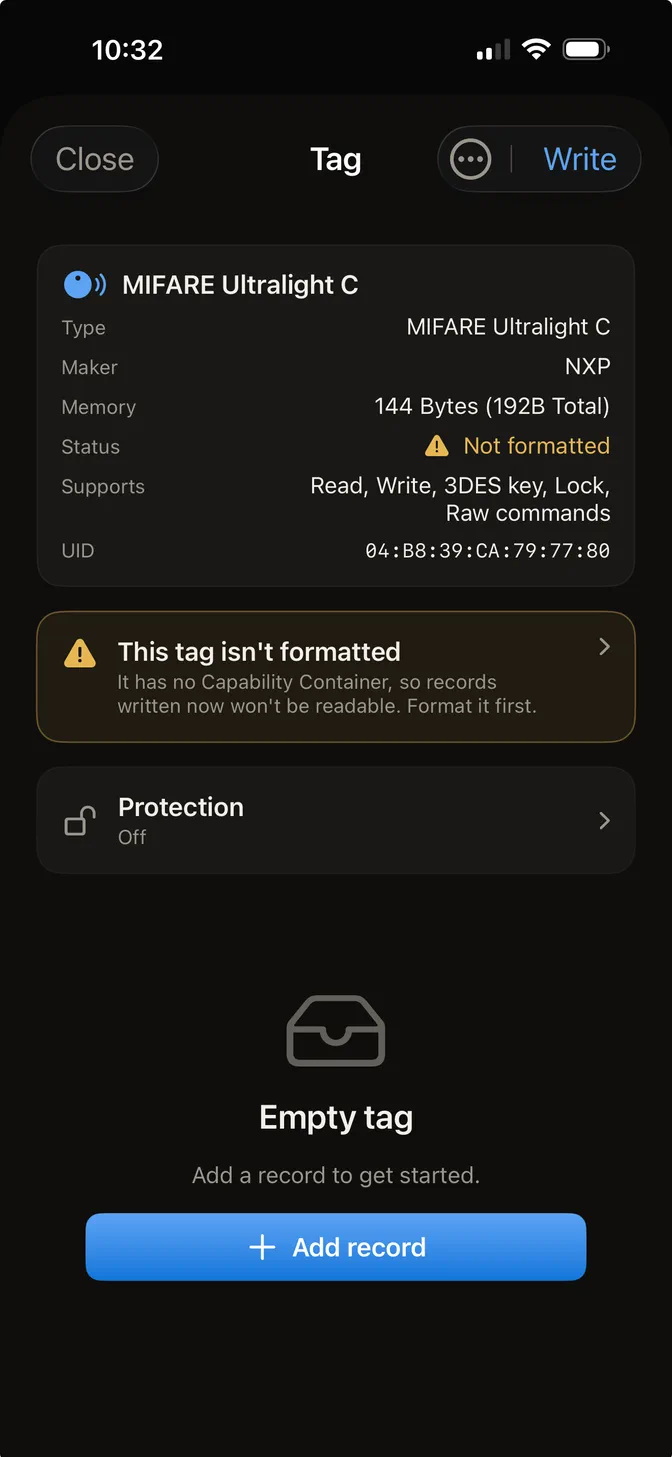
Chip identified, capabilities listed, unformatted tags called out. 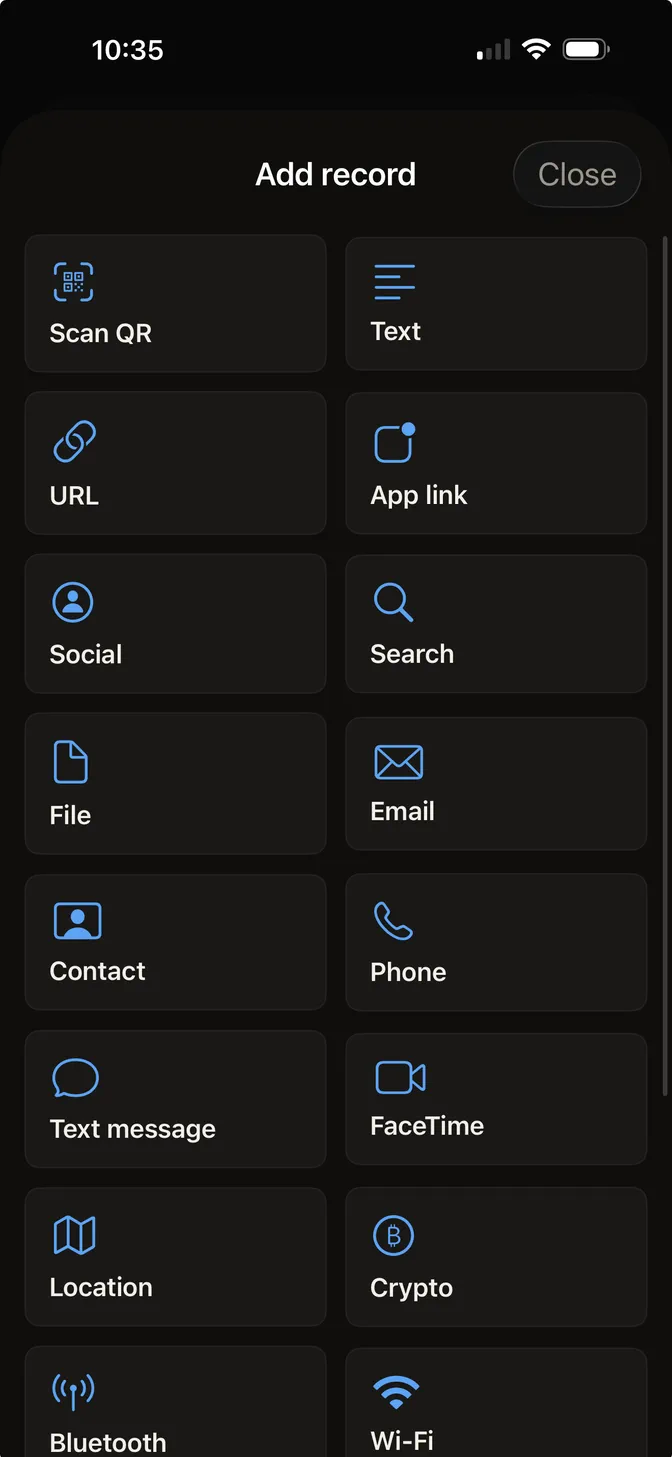
Eighteen record types, including Wi-Fi and Shortcuts. 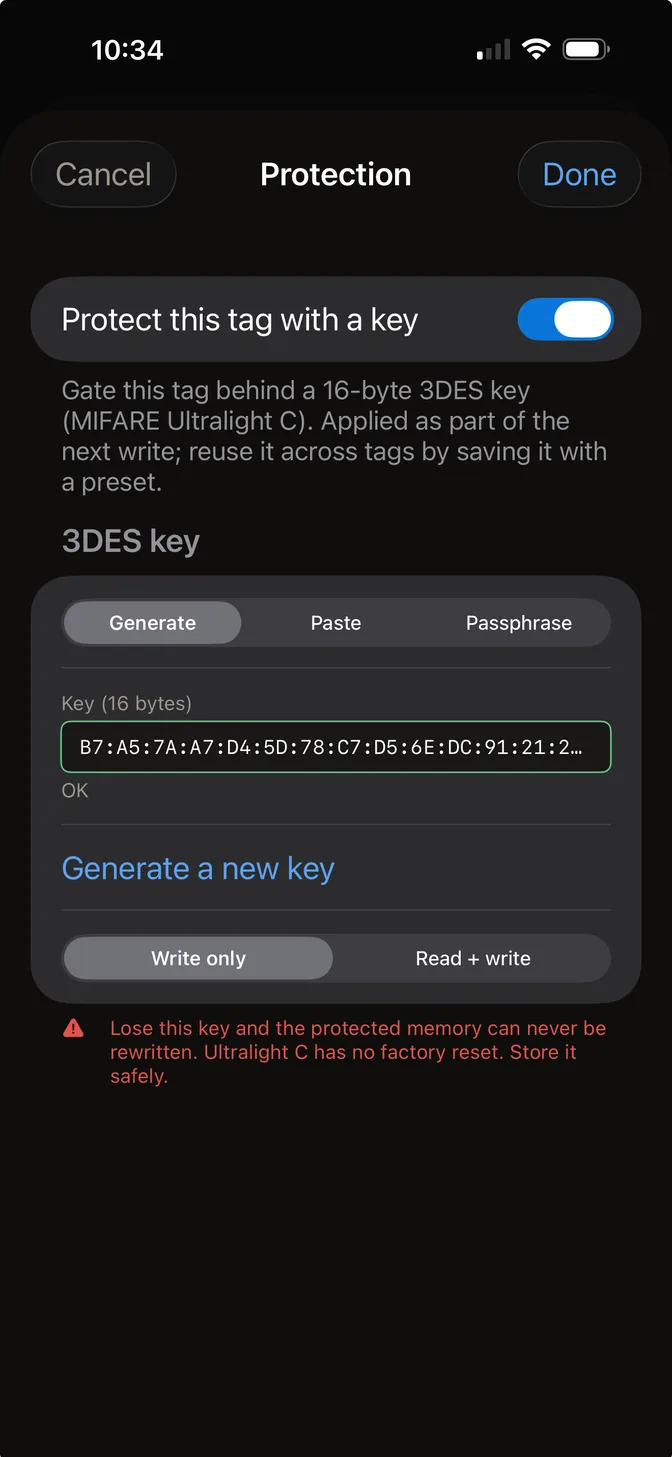
AES-128 on NTAG424 DNA, 3DES on Ultralight C. 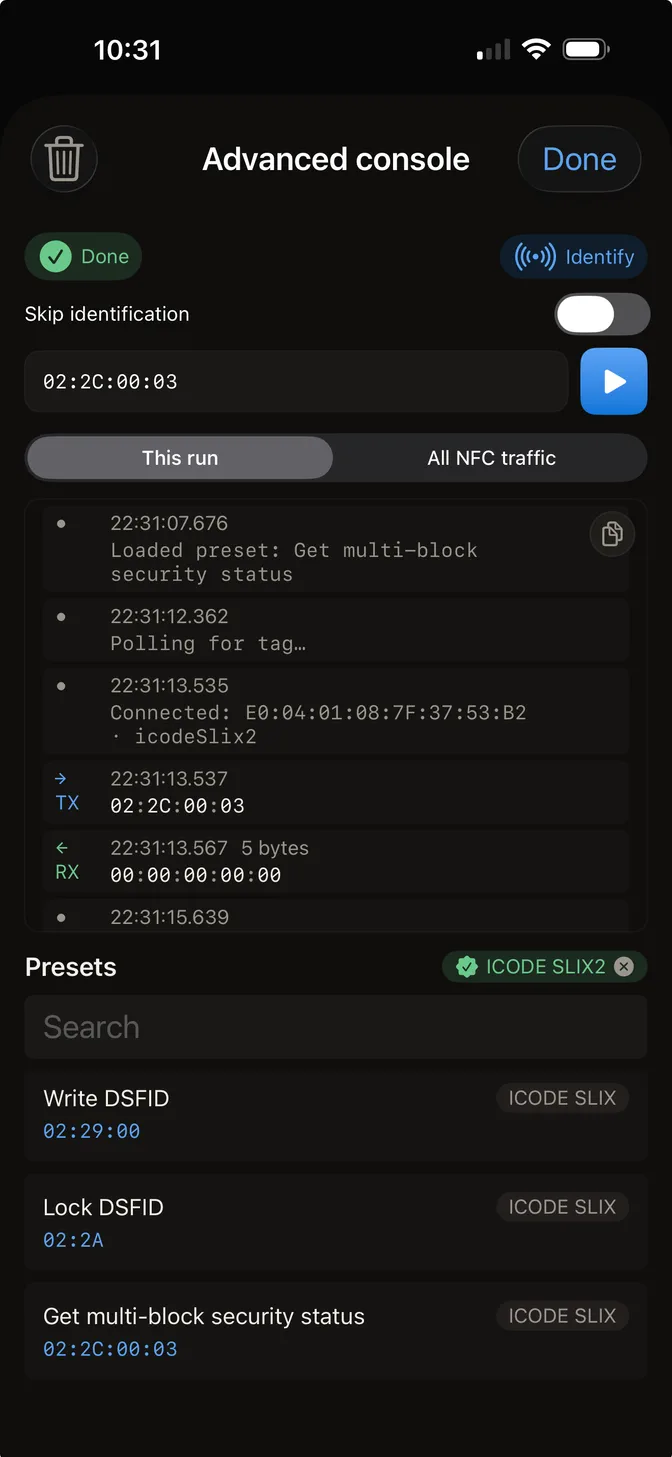
Raw commands, curated presets, a live trace you can read. 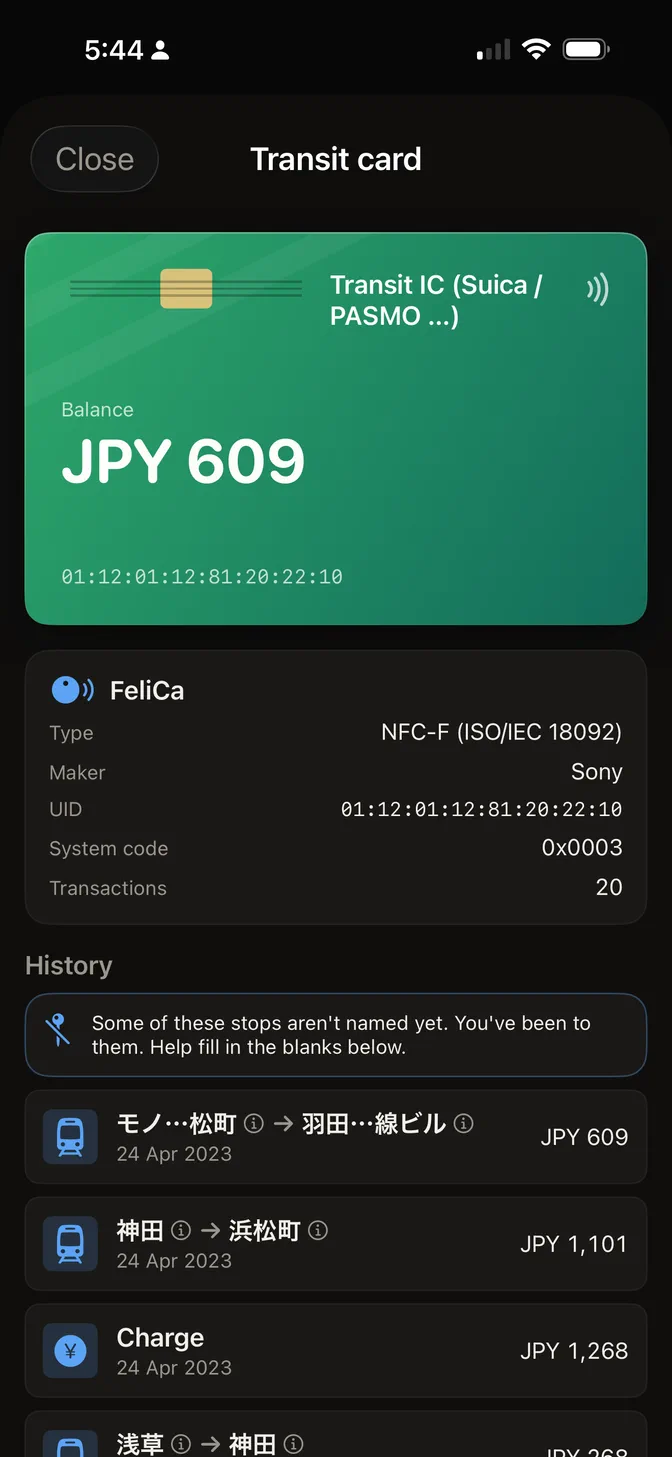
Balance and trip history, read straight off the card.
Protection
Lock a tag properly, per chip family.
Re-scanning a protected tag asks for the right credential for that family and routes it to the matching backend, rather than trying one scheme and giving up.
Credentials live only in the device Keychain, restricted to this device while unlocked. They are never written to the database, never included in an exported tag file, never synced to iCloud, and are masked in diagnostic traces.
Irreversible operations (erase, format, permanent lock) sit under their own heading and each require you to type the tag's UID to confirm.
NTAG213 / 215 / 216, Ultralight EV1
Four-byte password and acknowledgement, with the protection start page, the read/write protection bit and the failed-attempt limit all exposed under an advanced disclosure.
NTAG424 DNA
Gate the file behind a 16-byte AES-128 key via the EV2 secure-messaging handshake, optionally requiring the key to read as well as write.
MIFARE Ultralight C
A 16-byte two-key 3DES credential with a mutual authentication handshake. Generate one, paste one, or derive one from a passphrase.
ICODE SLIX / SLIX2
A four-byte write password through the challenge-response exchange, with an optional read and privacy password. A tag locked here stays unlockable by other standards-compliant tools.
Beyond tags
Two things you probably didn't know your phone could do.
Your own passport
Enter the key printed in the machine-readable zone, hold the passport to the phone, and Hex NFC reads the data groups: name, date of birth, the photograph. It uses PACE with a fallback to BAC, and checks the signed data groups for tampering.
It deliberately makes no authenticity claim. Without a certificate trust store it can tell you a chip's contents are internally consistent, not that the document is genuine, and it says so rather than implying otherwise.
The key is held in memory for one read and then dropped. The passport data is never saved, synced, exported or transmitted.
Transit cards
Tap a Suica or PASMO card and see its balance and trip history, rendered as a replica of the card itself, with station names from a pack bundled in the app.
When a stop has no name, you can type one and submit it. Only the numeric station codes and the name you typed are sent. Never the card identifier, never the balance, never the history.
Verified
Every chip here has been held against a real phone.
Plenty of NFC support is written from a datasheet and never touched to a tag. Hex NFC separates the two: the chips below have been read, written, protected and unlocked against physical silicon on physical hardware, not simulated.
- NTAG 210µ
- NTAG213
- NTAG216
- NTAG424 DNA
- Ultralight EV1 128b
- Ultralight C
- ICODE SLIX
- ICODE SLIX2
- DESFire EV3
- FeliCa
Everything else in the support matrix is implemented and documented, and marked as untested until it has been. That is also why the app refuses to format a tag it cannot identify: the capability container is one-time programmable, and a guess there is permanent.
For the curious
A raw command console, in a free app.
Send raw commands and APDUs directly to the chip and read what comes back, with curated preset libraries for NTAG21x, NTAG424 DNA, ISO 15693, Ultralight EV1 and EM Microelectronic parts, and room to save your own. Switch the trace between the current session and all NFC traffic and watch the exchange as it happens.
Long-press any error to copy the full diagnostic for a bug report. Device quirks are documented honestly, including the ones that are iOS limitations rather than app bugs.
The difference
The features behind the paywall are the ones you needed.
| Feature | Most NFC apps | Hex NFC |
|---|---|---|
| Writing tags | Paid | Free |
| Password protection | Paid | Free |
| Saving and loading presets | Paid | Free |
| Importing from NFC or QR | Paid | Free |
| Memory editor and raw commands | Paid | Free |
| Third-party advertising | Some | None, ever |
| Source code | Closed | Published |
Privacy
Don't trust the claim. Read the code.
The privacy manifest is committed in the repository and is the source of truth: every network call the app makes is documented by file and by line. There are three, and none of them carries personal data.
Source at release- No third-party ads. The only thing promoted is another Hex Pro app.
- No analytics. Not first-party, not third-party, not a single SDK.
- No accounts. Nothing to sign up for, nothing to lose.
- Source-available under BSL 1.1, converting to Apache 2.0 in 2030.
In the open
What it cost to build, and how much has come back.
Hex NFC makes no money. Rather than hint at that, the exact figure is published and itemised, down to the postage on a bag of test tags, and the same number is shown on the app's own home screen.
A$0.00 of A$280.02
0% recovered · AUD
Detail
The specifics.
- Platform
- iPhone, iOS 17 or later
- Status
- Pre-release. Version 1.0.0 ships with the App Store launch.
- Pricing
- Free. No accounts, no subscriptions, no in-app purchases, no paid features.
- Licence
- Business Source License 1.1, converting to Apache 2.0 on 1 June 2030
- Record types
- 18 NDEF types, plus raw byte editing
- Chip families
- NTAG 210µ / 213 / 215 / 216 / 213 TT, NTAG424 DNA, Ultralight EV1 and C, ICODE SLIX and SLIX2, ST M24LR, EM Microelectronic V10 / V11 / V16, FeliCa Lite-S (read), DESFire EV1 / EV2 / EV3 (identify and raw)
- Privacy
- No third-party ads, no analytics, no accounts. Three documented network requests, none carrying personal data.
- Languages
- English, Mandarin, Arabic, Spanish, Japanese, French, Brazilian Portuguese
Questions worth asking.
- Is Hex NFC really free?
- Yes. There are no accounts, no subscriptions, no in-app purchases and no paid features, and there is no third-party advertising. It is funded by voluntary donations against a published development cost, and giving unlocks nothing because there is nothing locked.
- What does source-available mean here?
- The full source is published with the release, and you will be able to read every line of it. It is licensed under the Business Source License 1.1, with an additional grant covering personal, non-commercial use, and it converts to Apache 2.0 on 1 June 2030. The practical difference from a permissive licence is that you cannot ship a commercial fork until that date. Everything else you can do: read it, build it, audit the privacy claims, send fixes.
- Which NFC chips does it support?
- NTAG 210µ, 213, 215, 216 and 213 TT, NTAG424 DNA, MIFARE Ultralight EV1 and Ultralight C, ICODE SLIX and SLIX2, ST M24LR, EM Microelectronic V10, V11 and V16, FeliCa Lite-S for reading, and DESFire EV1, EV2 and EV3 for identification and raw commands. MIFARE Classic is not supported, because no iPhone can talk to it.
- Can it really read a passport?
- It can read the data groups on an ICAO-standard electronic passport once you supply the key printed in the machine-readable zone, using PACE with a fallback to BAC. It checks the signed data groups for tampering and reports that, but it makes no claim about authenticity: there is no certificate trust store, so it can tell you the chip's contents are internally consistent, not that the passport is genuine.
- What does the app send over the internet?
- Three requests, none carrying personal data: the public development-cost figure, a station name you choose to submit for an unnamed transit stop, and the Hex Pro promo banner. The privacy manifest is committed in the repository and documents every network call by file and line.