 Nepali Companion
Nepali Companion
Learn to read Nepali.
A chapter book you play through. Each chapter teaches a small set of letters or grammar, then hands them straight to an arcade game where the learning action is the game action.
iPhone · iOS 17+ · No accounts, no analytics
The guide
Real words from chapter one.
Twenty-six written chapters take you from the first consonant to reading a street of Nepali signboards, none of it romanised. Every word is script-legal at the point it appears, which means it only uses letters and vowel signs you have already been taught. That is enforced by a build check rather than by carefulness, so it cannot quietly drift.
Along the way: the vowel signs and how they attach, Devanagari digits, the minimal pairs that trip up every English speaker (काल and खाल, ताल and थाल and टाल), and the honorific system that decides whether you sound rude or absurdly formal.
Anything needing a native speaker or a dictionary to confirm goes into a queue. It is never guessed at. Nearly all of that queue is still open, and it has to be answered before the app can be released publicly.
On the screen
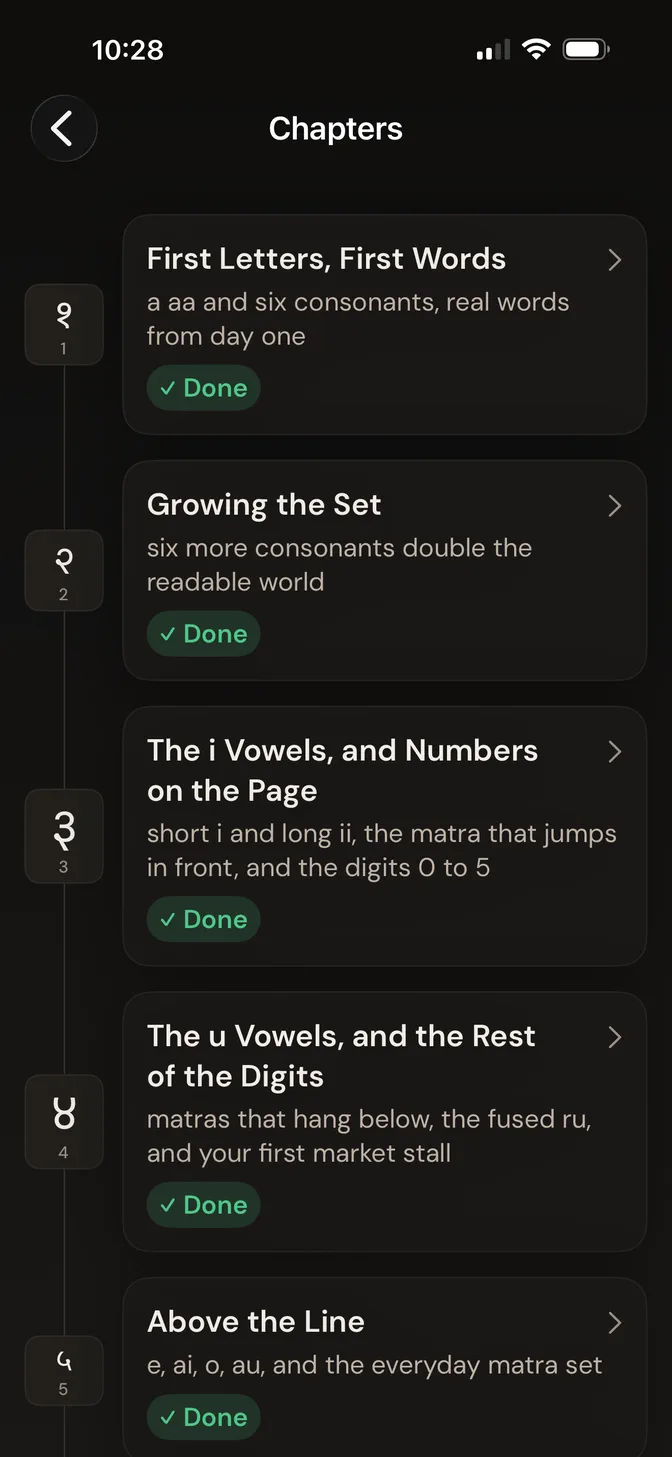
Twenty-six chapters. Real words from the first one. 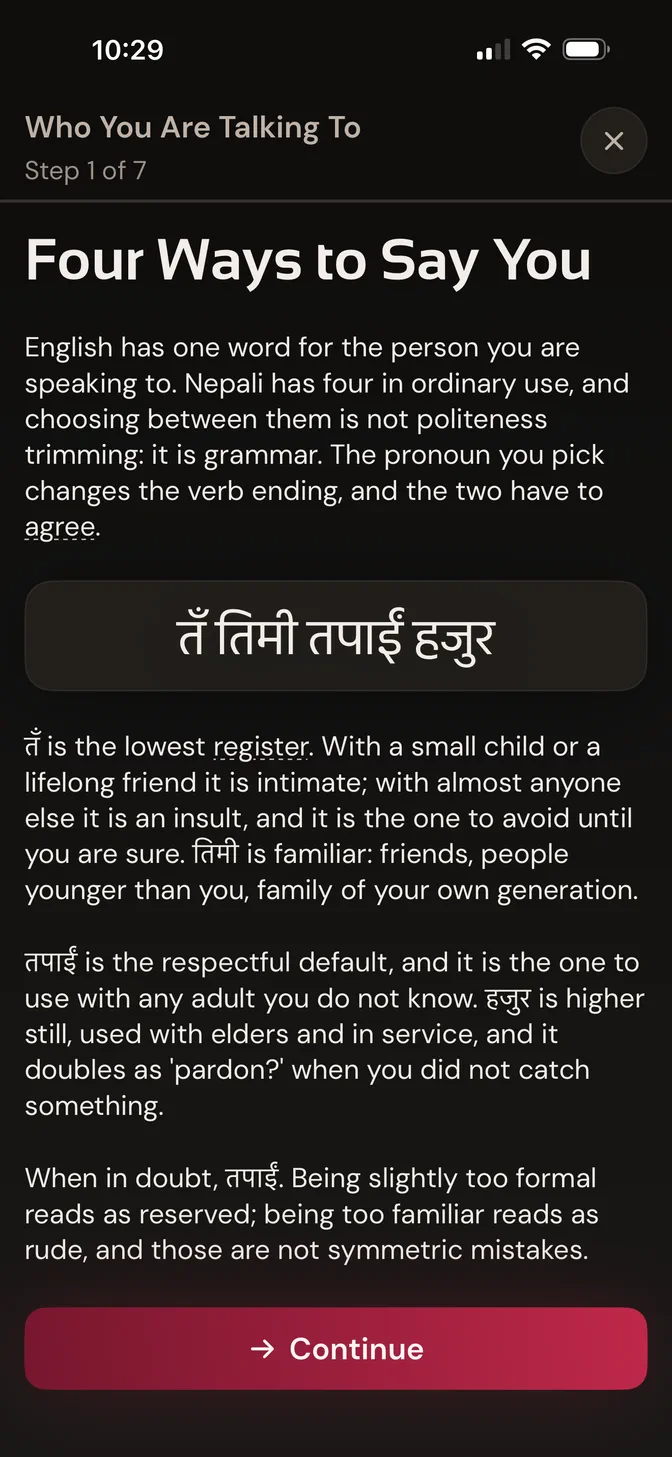
A chapter step in full. This one is the four Nepali words for you. 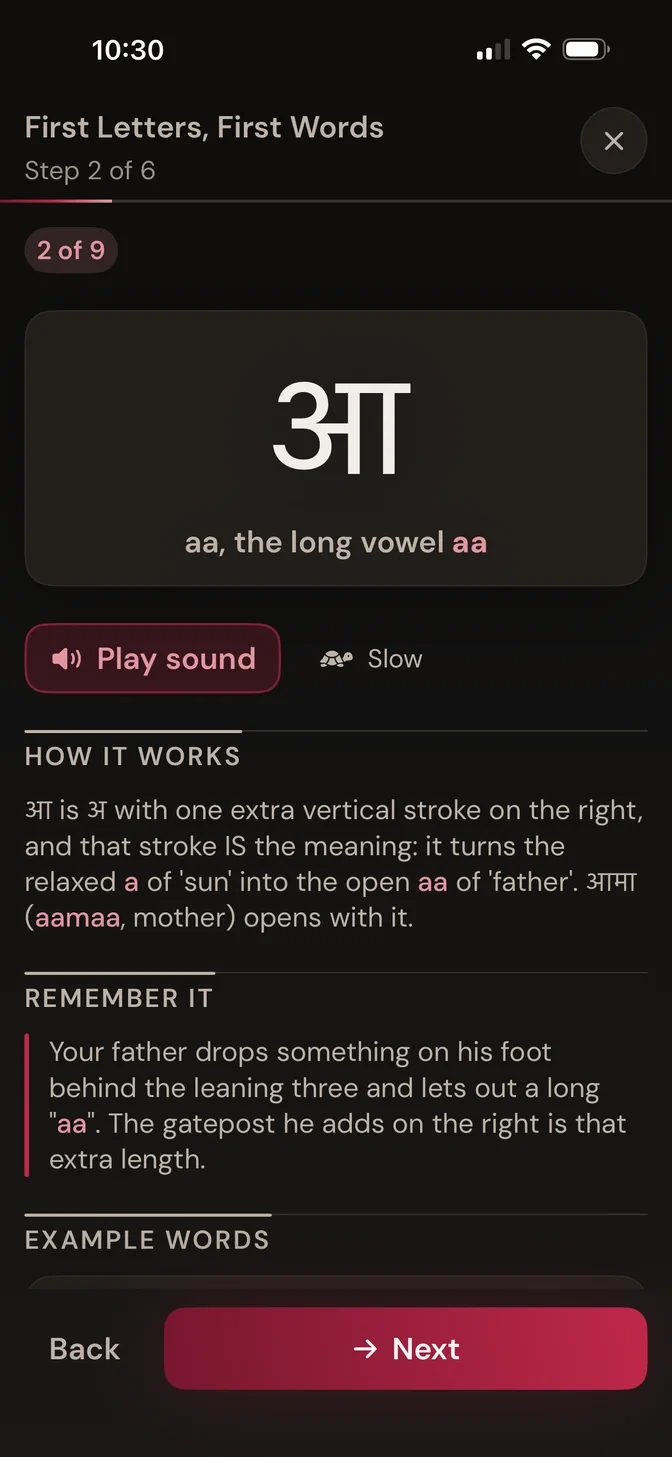
Every letter gets how it works, how to remember it, and words that use it. 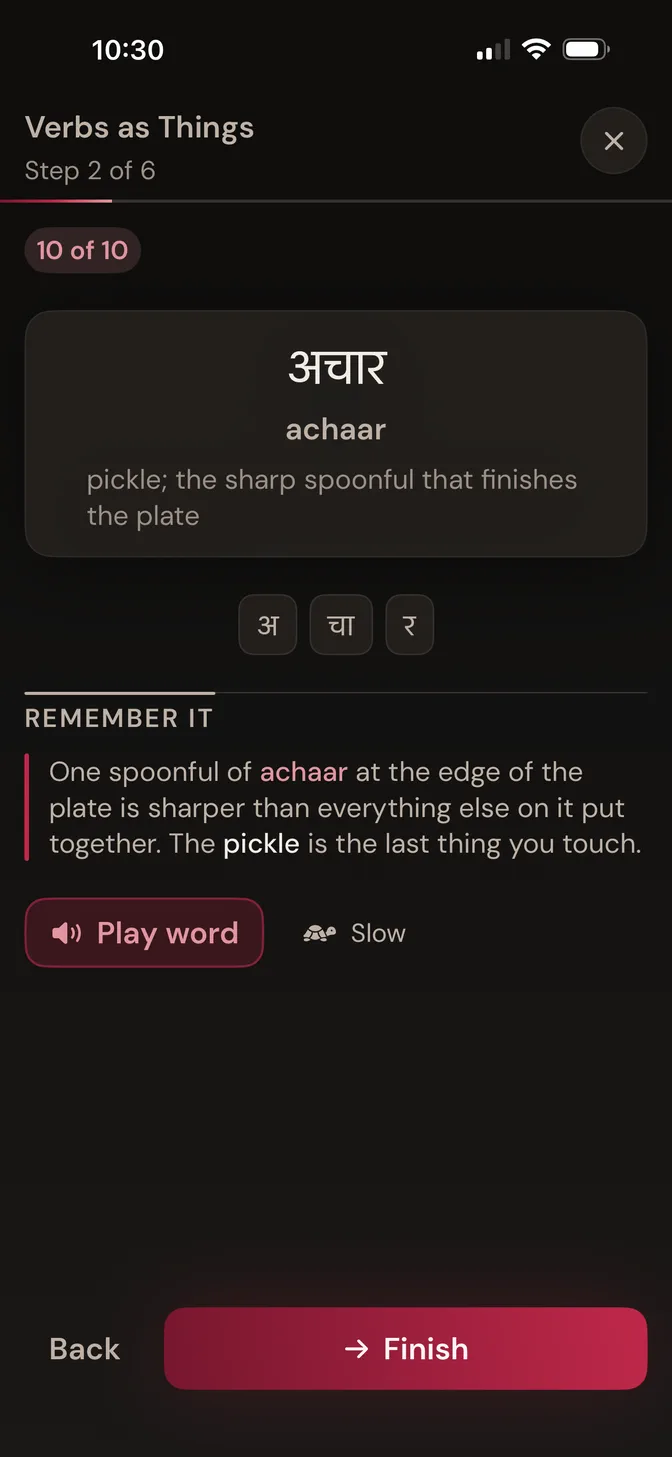
Words arrive segmented, with audio and a mnemonic already written. 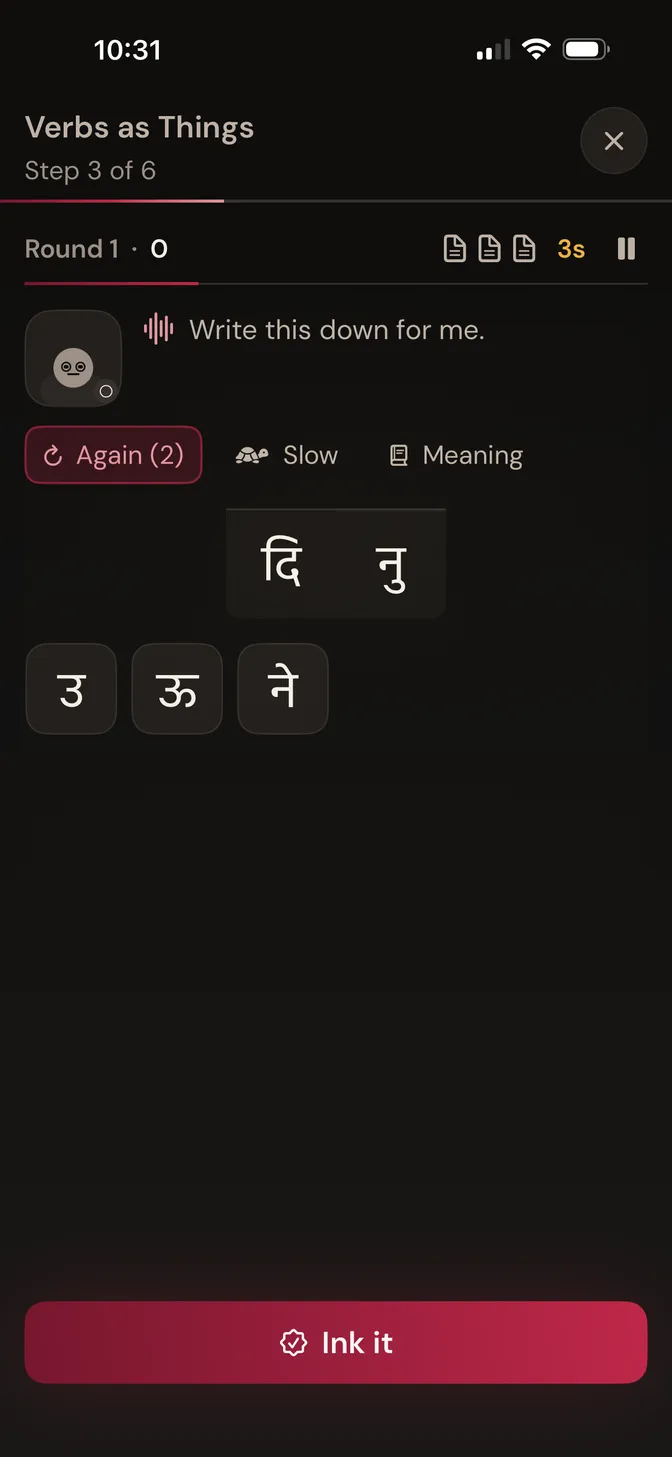
Then a round: spell what you just heard, from the tiles. 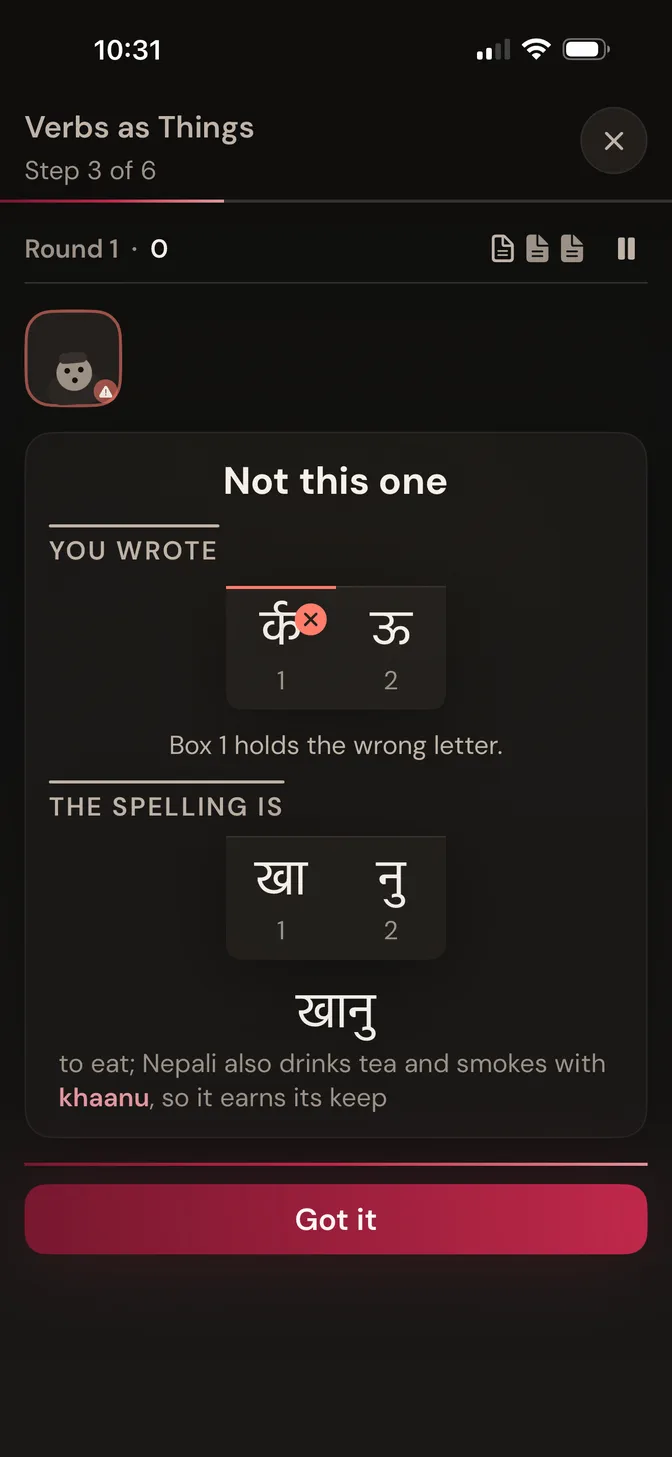
A wrong answer says which box was wrong, and what the word actually was. 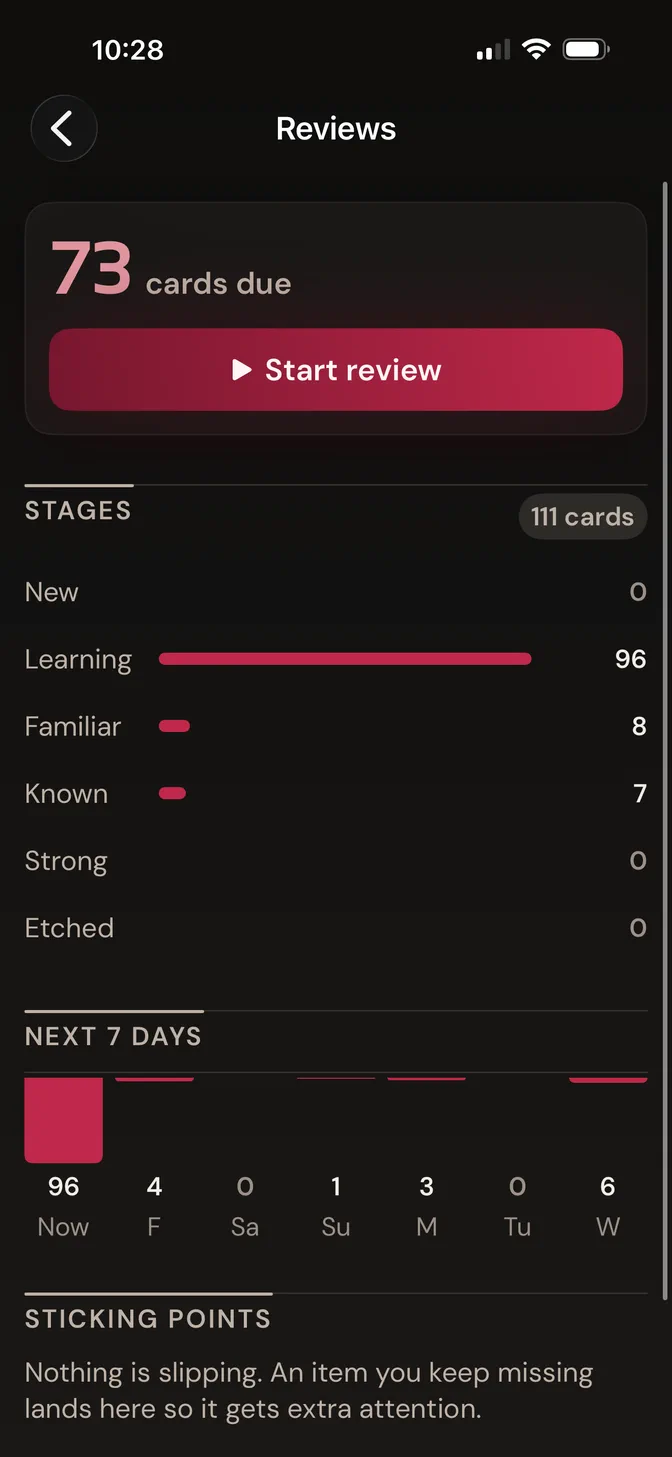
Scheduled by FSRS, filled automatically as you learn. 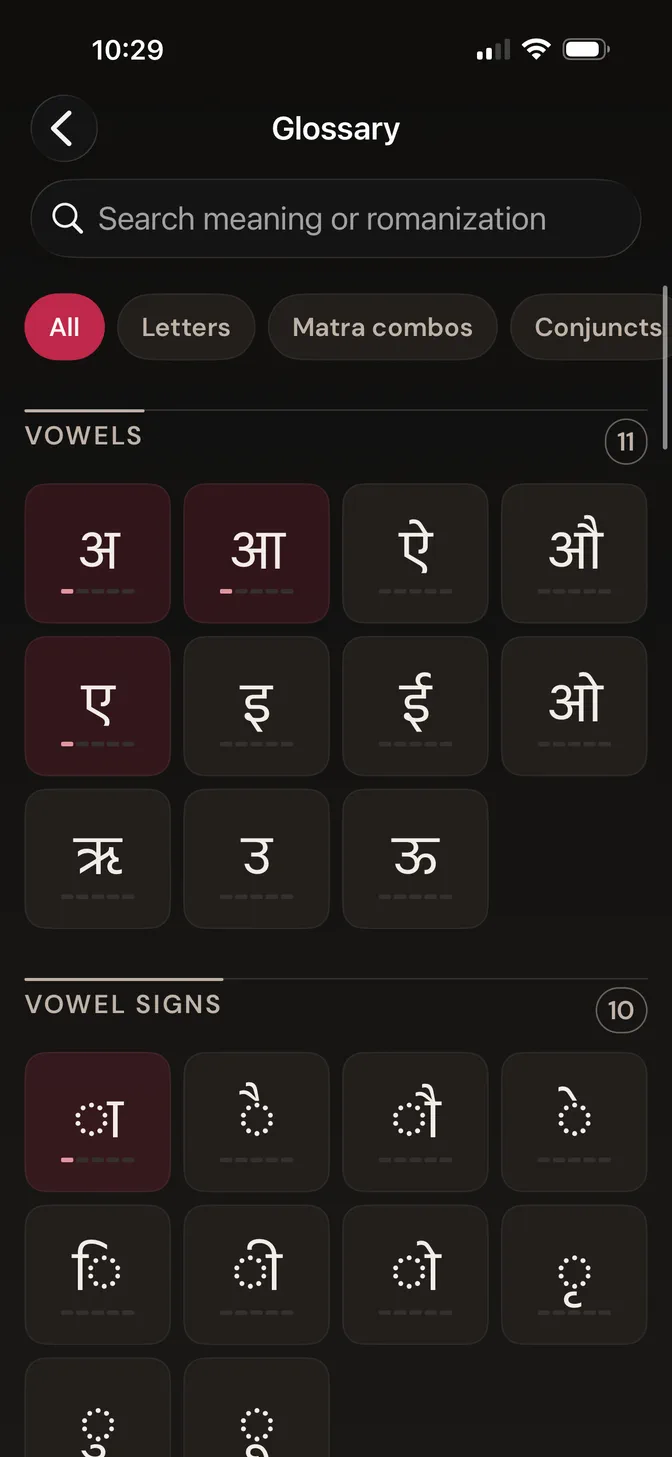
Every letter, sign and conjunct you have met, with its review stage under it.
Ten activities
The thing you are learning is the thing you are doing.
Not a quiz with a score attached. Each activity is built so that the mechanic and the lesson are the same action.
- 01
Akshara Defence
Glyphs descend the screen. Type a letter's romanisation and the shot goes off on the last keystroke, or take it early with the fire bar. Six tiers of content, from plain consonants up to the letters that look almost identical to each other.
- 02
Matra Forge
Hear a syllable, then drag the vowel sign onto the base consonant. The composition animation is the teaching: ि swings to the left, ु tucks underneath.
- 03
Conveyor Belt Orders
A spoken order, goods riding a belt, and a hand that has to keep up. Fulfil it correctly and the finished dish is revealed.
- 04
Sound Interceptor
A clip plays and you pick from one curated family of minimal pairs. Choosing wrong replays the contrast back to back, which is the whole lesson.
- 05
Sentence Forge
Assemble chunks on slot rails, with rival copulas and wrong agreement mixed in, then cast the finished sentence as a spell.
- 06
Market Rush
Hear a request, tap the goods, enter the total on a Devanagari numeral pad, and count out the change. The customer's patience is finite.
- 07
Respect Check
A situation and a person, and you choose the pronoun and the verb form to match. Only a pronoun and a verb ending from different registers counts as a grammar mistake. Being too formal scores below the natural reply but is never marked wrong, because that is how politeness actually works.
- 08
Conjunct Kiln
An order names a cluster and plays it. Stack its parts onto the rack, halanta and all, and the kiln fires them into the single akshara they make. The same cluster also arrives fused for you to take apart, and punched out of a word to rebuild.
- 09
Spelling Scribe
A customer dictates a word and the slip in front of you shows one empty box per akshara. Get three right in a row and the tray starts offering letters that sound identical to the ones in the word, so the ear stops being enough.
- 10
Street Errands
An errand arrives, and the street is a column of boards: shopfronts, a bus stand, a notice board. Tap the shop it asks for, or type what the bus board says to buy the ticket. Nothing on the street is romanised, so reading is the only way through.
Review
Reviews arrive when you are about to forget.
Everything the guide teaches is enrolled into a spaced repetition scheduler automatically, so there is no separate deck to build and nothing to maintain. An item is enrolled once for each skill it is authored for, so most items carry two or three cards rather than one, and reading a word is scheduled apart from hearing it. Playing an activity is reviewing: the first time an item comes up in a game, your answer grades the card for the skill it is testing.
What is due, and where it all sits
The Reviews screen leads with the number of cards due, then shows where every card sits on the ladder: New, Learning, Familiar, Known, Strong, Etched. Below that is what is coming over the next seven days, and a short list of the items you keep missing. That last list has a clinic attached, which drills a slipping item against the ones it keeps being mistaken for. Whether that has worked is the scheduler's call and not the clinic's.
A gate between chapters
Before a chapter opens, the app checks the one behind it. If your predicted recall across its items has fallen under 85 per cent, or three of them have lapsed at least four times and still are not sticking, you sit that chapter's checkpoint again first. It is rebuilt from the items you are weakest on, twelve at most. Finishing it is what opens the next chapter. How you score on it is not.
A glossary that pulls things apart
A word comes apart into its aksharas, and any akshara built from more than one piece comes apart again into those pieces. Every item carries its romanisation, its audio at normal speed and slowed down, and a review stage for each skill it is enrolled on. Letters, words and conjuncts each carry a memory hook. A consonant also gets its barhakhari row, that letter under every vowel sign you have met.
Audio on everything
549 clips ship inside the app, spoken by two Nepali neural voices rather than Hindi ones. That is one for every item the guide teaches so far, sentences included. Each clip is filed under its item's id, so a native speaker recording can replace it later with no change on the app's side, which is the plan rather than a hypothetical.
Privacy
Your progress stays on your device, because no code in the app sends it anywhere.
No accounts, no sign in, no analytics, no third-party advertising, no trackers and no crash reporting service. The app asks for no microphone, camera, contacts or location access, because it does not use any of them. The one permission it ever asks for is notifications, and it asks once, after your first completed review session rather than at launch, so a reminder can arrive when reviews fall due. Refusing it changes nothing else.
There is one thing in the app that opens a network connection. Until you buy the course, the foot of the home screen may show a banner for another Hex Pro app: fetching it sends this app's bundle identifier, the platform and which slot it is filling, and returns a picture or a video. It carries nothing that identifies you, and everyone sees the same banner. Buying the course removes the banner and stops the request. The purchase is handled by Apple. Deleting the app deletes everything it stored on your device.
You do not have to take that on faith. An app whose only outbound request is that one banner fetch is an app you can watch make it, from a proxy or a network monitor on your own machine. The privacy policy below describes the same request, and it is the same text that ships inside the app.
Detail
The specifics.
Nepali Companion is in active development. The guide, the theory modules and the activities are built and playable, and the chapters and their audio ship inside the app. What is left is not code: the App Store Connect setup, the checks that need a physical device or a person rather than a test runner, and a native-speaker review of the Nepali wording that is tracked item by item and still mostly open.
- Platform
- iPhone, iOS 17 or later
- Status
- Feature complete and in testing. Not yet on TestFlight.
- Pricing
- Free download with chapters 1 to 3. One purchase of US$8.99 opens the remaining twenty-three and removes the Hex Pro banner. Planned at launch.
- Licence
- Proprietary. All rights reserved.
- Teaches
- Nepali, written in Devanagari, for English speakers
- Content
- Twenty-six authored chapters, 173 vocabulary words, 549 bundled audio clips
- Review
- FSRS-5 spaced repetition at a 90% retention target, populated automatically from your progress
- Privacy
- No accounts, no analytics, no third-party advertising. Network use: the in-app purchase, and a Hex Pro banner that the purchase removes. The only permission it asks for is notifications, after your first completed review session.
- Accessibility
- Reduce Motion honoured throughout, games fully playable with all effects off, and no meaning ever carried by colour alone
Questions worth asking.
- Do I need to know any Devanagari to start?
- No. Chapter one assumes you cannot recognise a single letter, and it introduces real Nepali words from that first chapter rather than making you drill the alphabet in isolation for a fortnight.
- Is this just a Hindi app relabelled?
- No, and that distinction is the reason it exists. The pronunciation guidance, the honorific system and the vocabulary are Nepali. The audio uses Nepali neural voices, because Hindi voices are phonologically wrong for Nepali and every learner can hear it.
- Does it need an internet connection?
- The course does not. The lessons, images and audio are in the download, and reminders are scheduled locally by iOS if you turn them on. There are no accounts and nothing to sign in to. Two things do use the network: the in-app purchase, which Apple handles, and a banner for another Hex Pro app at the foot of the home screen, which the purchase removes.
- How much does it cost?
- The app is a free download and chapters one to three are in it. One purchase of US$8.99 opens the rest. It is a one-time purchase rather than a subscription, and there is no subscription code in the app. Nothing is on sale yet, because the app has not been submitted.